

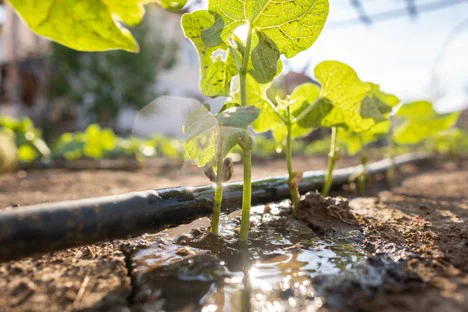
Commercial landscapes have a different irrigation challenge than residential properties. A single site may include planting beds, trees, shrubs, turf, parking areas, walkways, and dozens of irrigation zones, all with different water requirements. When that system relies on broad spray coverage, even small inefficiencies can add up quickly.
Drip irrigation offers a more targeted approach. Instead of distributing water through the air across a wide area, drip systems deliver measured amounts of water directly to the soil near plant roots. For commercial properties with extensive planting beds and other areas that do not require traditional spray irrigation, that precision can make a meaningful difference.
Why Is Drip Irrigation So Effective for Commercial Properties?
The basic advantage of drip irrigation is control. Water is delivered slowly and close to the plants that need it, reducing the amount lost before it reaches the root zone.
That can be particularly valuable across large commercial landscapes, where even a small amount of unnecessary water use in each zone can become significant when multiplied across an entire property.
Commercial drip irrigation can help address common sources of inefficiency, including:
- Evaporation. Water released near the soil surface is less exposed to wind and direct sunlight than water distributed through overhead spray.
- Overspray. Properly positioned drip emitters can keep water within planting areas instead of sending it onto sidewalks, buildings, or parking lots.
- Uneven distribution. Properly designed drip zones can provide more consistent water delivery across beds with similar plant requirements.
- Runoff. Slow application rates give soil more time to absorb water, which can help reduce runoff on appropriate sites.
- Unnecessary watering. Targeted delivery makes it easier to match irrigation output to the needs of specific plants and planting areas.
The larger the landscape, the more those small improvements can matter.
Where Does Drip Irrigation Make the Most Sense?
Not every part of a commercial landscape should be converted to drip irrigation. Turf areas, large open spaces, and other landscapes may be better suited to sprinklers designed for their specific coverage requirements.
Drip irrigation is often particularly useful in areas such as:
- Shrub & planting beds. Individual emitters can deliver water directly to established plants without unnecessarily watering surrounding hardscape.
- Tree & ornamental plantings. Targeted irrigation can provide consistent moisture around root zones while avoiding excessive surface watering.
- Narrow landscape strips. Drip systems can be useful where traditional spray patterns would overshoot the planting area.
- Areas near hardscapes. Controlled application can help reduce water reaching sidewalks, buildings, driveways, and other non-landscaped surfaces.
- Densely planted beds. Multiple emitters can be arranged to provide coverage across areas containing different plants with similar irrigation requirements.
The goal is not simply to install drip everywhere. It is to use the right irrigation method for each part of the property.
How Does Drip Irrigation Improve Water Efficiency at Scale?
A commercial irrigation system can contain hundreds or even thousands of individual components. That means efficiency depends on more than whether the system turns on and off at the correct times.
Every emitter, valve, zone, and controller setting contributes to overall performance. A well-designed commercial drip irrigation system can improve efficiency by allowing property managers and irrigation professionals to control several variables more precisely.
This includes:
- Application rates. Emitters can deliver water at measured rates rather than relying on broad spray patterns.
- Zone management. Areas with similar plant material and water requirements can be grouped together for more appropriate scheduling.
- Root-zone delivery. Water is applied closer to where plants can use it, rather than dispersed across the surrounding landscape.
- Scheduling flexibility. Controllers can be programmed around the characteristics of individual zones and adjusted as seasonal conditions change.
- System monitoring. Changes in pressure, flow, or plant performance can help identify problems before they become larger sources of waste.
That level of control becomes increasingly valuable as the size and complexity of a commercial landscape increase.
What Can Go Wrong with Commercial Drip Systems?
Drip irrigation is efficient, but it is not maintenance-free. Because emitters and lines operate close to the soil and plants they serve, problems can sometimes be difficult to spot until a plant begins showing signs of stress.
Common issues include:
- Clogged emitters. Sediment or mineral buildup can restrict water flow through individual emitters.
- Damaged tubing. Landscape work, animals, weather, or routine property maintenance can damage exposed sections of dripline.
- Disconnected fittings. Loose or damaged connections can cause leaks or prevent water from reaching intended areas.
- Pressure problems. Drip systems require appropriate pressure to distribute water consistently throughout a zone.
- Poor emitter placement. As plants grow, emitters may no longer be positioned where water is most useful.
- Controller problems. An efficient irrigation system can still waste water if its schedule does not reflect current landscape conditions.
Because many of these problems are not immediately visible, routine inspection is an important part of maintaining efficiency.
How Can Commercial Properties Keep Drip Systems Performing Efficiently?
Installation is only the beginning. Commercial landscapes change throughout the year, and irrigation systems need to change with them.
Regular maintenance can include checking emitters, inspecting tubing and connections, evaluating pressure, adjusting schedules, and identifying areas receiving too much or too little water.
It also helps to pay attention to what the landscape is communicating. Dry plants, saturated soil, erosion, unexpected weed growth, or unusually high water consumption can all indicate that an irrigation zone needs attention.
A professional irrigation inspection can provide a broader look at system performance and identify problems that may not be obvious during a routine property walkthrough.
Is Drip Irrigation the Right Choice for Every Commercial Landscape?
Drip irrigation can be an excellent tool for commercial water management, but the most efficient system is not necessarily one that uses the same irrigation method everywhere.
Commercial properties often benefit from combining technologies according to the needs of each landscape area. Spray or rotor irrigation may make sense for open turf, while drip irrigation can provide more targeted delivery in planting beds and around individual plants.
The important consideration is whether each zone is designed and managed according to what the landscape actually needs.
A properly evaluated irrigation system takes factors such as plant type, soil, slope, sun exposure, pressure, and existing equipment into account. That approach allows property managers to use drip irrigation where it provides the greatest benefit rather than treating it as a one-size-fits-all solution.
How Does Conserva Help Improve Commercial Irrigation Efficiency?
Commercial irrigation efficiency starts with understanding how a system is performing today. At Conserva Irrigation, our approach focuses on helping property owners and managers use water more effectively through thoughtful system design, maintenance, repairs, and ongoing adjustments.
For properties where drip irrigation makes sense, professional evaluation can help determine appropriate zones, emitter placement, pressure requirements, and scheduling. Regular inspections can then help keep those systems operating as plants grow and conditions change.
Whether a commercial landscape needs drip irrigation installation, repairs, system adjustments, or a broader irrigation evaluation, the objective remains the same: deliver the water the landscape needs without wasting what it does not.
What Should Commercial Property Managers Know About Drip Irrigation?
Drip irrigation can make a significant difference when it is properly designed, installed, and maintained. For large commercial properties, even incremental improvements in water delivery can add up across numerous zones and throughout an entire irrigation season.
A few key takeaways:
- Precision matters. Delivering water closer to plant roots can reduce unnecessary losses.
- The right system depends on the landscape. Drip is particularly useful for planting beds, shrubs, trees, and other targeted areas.
- Maintenance remains essential. Clogged emitters, damaged lines, pressure problems, and poor scheduling can undermine efficiency.
- Scale changes the equation. Small inefficiencies become more significant when repeated across a large commercial property.
- Professional evaluation helps. Regular inspections can identify opportunities to improve water delivery before problems become expensive.
For commercial property managers, efficient irrigation is ultimately about more than reducing water use. It is about maintaining healthy landscapes while making every gallon work harder. If you are considering drip irrigation for a commercial property or want to determine whether your existing system is operating efficiently, Conserva Irrigation can help.
Let our team perform a commercial site assessment and install a drip irrigation system tailored to your needs today. Call (804) 353-6999 or contact your nearest location online to discuss irrigation solutions for your landscape.
